EDUCATION MANAGEMENT INFORMATION SYSTEM (EMIS)
OVERVIEW OF EMIS
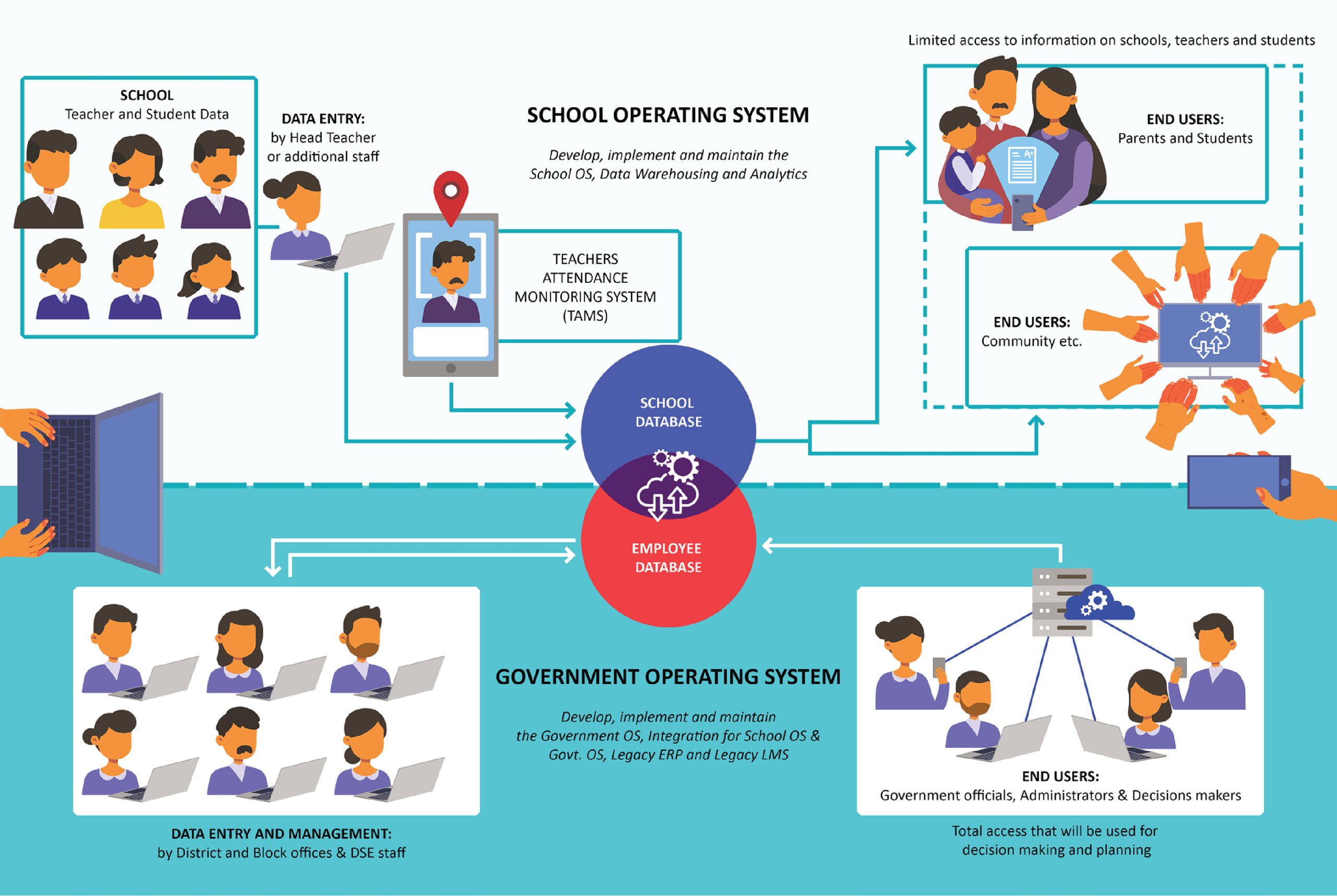
The NECTAR project, in collaboration with allied establishments — DoSE, SCERT, NBSE, and Samagra Shiksha — under the Department of School Education, is developing the Education Management Information System (EMIS). It will serve as a centralised portal for the comprehensive integration, maintenance, and access to data pertaining to the Department of School Education. The EMIS will be a pivotal tool in supporting the planning, administration, and operation of schools. It will be developed as a dual-layer application consisting of the Governance Operating System (GOS) and the School Operating System (SOS).
GOVERNANCE OPERATING SYSTEM (GOS)
GOS is the higher-level application designed to manage all administrative and policy-related operations at the state, district, and block levels. It will serve as a repository of data by consolidating information from schools, blocks, districts, and the State. This centralised system will be the authoritative source for state-wide datasets on education and supporting strategic decision-making and policy formulation.
SCHOOL OPERATING SYSTEM (SOS)
SOS will operate at the school level, focusing on the day-to-day management and operations of individual schools. The purpose of having a dedicated SOS along with GOS is to prioritise the needs of students, parents, school leaders, and teachers, ensuring that there is a focus on the schools as they are central to the overall enterprise of the EMIS architecture.
While the GOS provides centralised data warehousing and analytics for administrative and management decisions, the SOS plays a critical role in data collection at the school level. It captures essential datasets, such as student learning outcomes and offers student-level data analytics to teachers, school principals, and parents.
To ensure seamless data flow, GOS and SOS are designed to integrate and exchange information through an Application Programming Interface (API), enabling efficient upstream and downstream data transmission. Both systems serve as primary data sources, supporting a comprehensive and dynamic education management framework.
SIGNIFICANCE AND APPLICABILITY OF EMIS
The Educational Management Information System offers substantial benefits, particularly in the realm of data management. By integrating data from the Governance Operating System (GOS) and School Operating System (SOS) into a centralised data warehouse, EMIS will serve as a single, authoritative source of education datasets for the Department.
One of the key advantages of EMIS is its ability to enhance decision-making at various managerial levels—state, district, and block—by collecting, organising, and analysing data. The system’s centralised dashboard enables efficient storage, access, and management of all relevant data, providing a holistic view of the educational landscape.
The seamless integration of SOS with GOS through APIs further extends the system’s capabilities. EMIS can track student performance, store academic records, manage finances, and monitor teacher performance with ease. Additionally, attendance tracking and management can be largely automated, eliminating the need for manual oversight. Administrators can rely on automatically generated attendance reports and receive alerts for any issues that require attention.
Overall, the EMIS is essential for maintaining accurate and timely educational statistics and records, fostering evidence-based decision-making, and driving efficiency in data management across the entire education system.
The EMIS will serve as a unified platform for allied establishments under the Department, facilitating data collection, sharing, and minimising duplication and overlap. This collaboration will streamline processes, ensuring that data is efficiently managed and shared across establishments, enhancing overall operational efficiency.
DATA SECURITY
Before deployment, all applications will be certified by a Indian Computer Emergency Response Team (CERT-In) empanelled agency to ensure their security and reliability in the live application. The personal data of students, parents, teachers, administrators, stakeholders, and all other users will be safeguarded in compliance with the Indian Information Technology Act, 2000.
Data transfers may occur only when necessary for purposes such as application enhancement, integration, or societal and administrative development, and only with the approval of the State Legal Department and consent from the users. All user data will be encrypted and securely transferred to the Department of School Education servers housed at the State Data Centre, ensuring robust protection against unauthorised access.