FACES BEHIND NECTAR
This section features NECTAR officials in various roles to familiarise readers with the individuals and the purpose behind the project’s initiatives and interventions, as well as the strides made so far.
In this edition, we invite the Education Specialist from NECTAR to comment on his association with the project.
John Lohe
Education Specialist, NECTAR
- Kindly share with us briefly your association with the Directorate of School Education and the department as a whole during your active service.
A: The Directorate of School Education (DoSE) was more than my second home. As a planner, I put my heart and soul into understanding and visualising the system. I have travelled extensively across Nagaland to understand the ground realities. As a Research Officer, I was given the opportunity to represent the Department in regional and national level workshops, seminars, and review meetings. Though fairly a junior officer, I was appointed as State Educational Survey Officer in the 6th All India Education Survey (the first national digitised Education Survey). During my tenure as Joint Director, I was assigned as Senior Research Officer in the Planning Section, and I feel privileged to have worked closely with HoDs, AHoDs, and Ministers-in-Charge during that time.
Besides my regular duties, I was assigned to oversee the formulation and management of the newly launched Sarva Shiksha Abhiyan (SSA) as State Project Director (SPD) from 2001 until June 2009 (six months prior to my retirement), a position held by senior bureaucrats or IAS officers in other parts of the country. Serving as a planner, I experienced job satisfaction in SSA with full cooperation from a 200-strong, handpicked and trained support team drawn from the state, district, and EBRC levels, as this was the first decentralised elementary educational planning and management programme in the State. I was blessed with hand-holding support from HoDs, AHoDs, Ministers-in-Charge, and MHRD and EdCIL officials of that time.
I believe 2003 to 2009 was a golden era in School Education when every stakeholder participated with enthusiasm. As SPD, I had to represent Nagaland, and though relatively lower in status within the State, God gave me the strength to speak with conviction at the regional and national arenas. I was also granted the opportunity to be a member of the GoI-UNICEF-sponsored study team to Colombia, to study the famous Esquela-Nueva education system on the ground, a programme similar to our Communitisation programme.
I was also privileged to be one of the few selected officers to work closely with Shri K. T. Sukhalu (IAS), the then Director of School Education; Shri T. N. Mannen (IAS), the then Principal Secretary of School Education; and Shri R. S. Pandey (IAS), the then Chief Secretary and mind behind the Communitisation programme, leading to the formulation of the State’s Communitisation Act of 2002. The state-wide implementation of the concept in the school education sector went on to garner the Prime Minister’s Award and the United Nations’ Award.
2. When did you join the NECTAR project? Could you tell us about your role and assignment in it?
A: I joined NECTAR in 2022. My role was to provide necessary inputs on the current administrative set up and the working system of DoSE, hierarchical management and information flows, career management, and the Communitisation aspect vis-à-vis the Village Education Committee (VEC) and School Management and Development Committee (SMDC).
3. As a large department, the DSE has its fair share of management challenges that, in turn, affect the delivery of quality public school education. In your observation, is the NECTAR project ameliorating some of these issues?
A: The NECTAR project came in the nick of time when the Department was on the brink of collapse, facing huge manpower management problems, supervision and delivery system issues, the Communitisation Act management and implementation challenges after winning the awards, and, most importantly, inadequate collaboration between SCERT, NBSE, and Samagra Shiksha, even though schools and students remain our common focal points.
In my opinion, NECTAR is doing the much-needed work of tactfully handling the problems with utmost sincerity, professionalism, and commitment. In many cases it is guiding the Department back to the right track of managing and delivering quality education on the ground with the participation of all stakeholders, and initiating reforms at the much-needed levels, and, most importantly, fostering collaboration among all stakeholders.
4. How do you foresee the project’s initiatives influencing the education system? Additionally, do you anticipate any improvements in learning outcomes for students in the future as a result of the project?
A: NECTAR is a boon to the Department at multiple levels such as the management of manpower, improvement of delivery systems, professional training, supervision without punitive actions, and the development of Lighthouse School Complexes (LSCs) with modern facilities and strengthening of stakeholders.
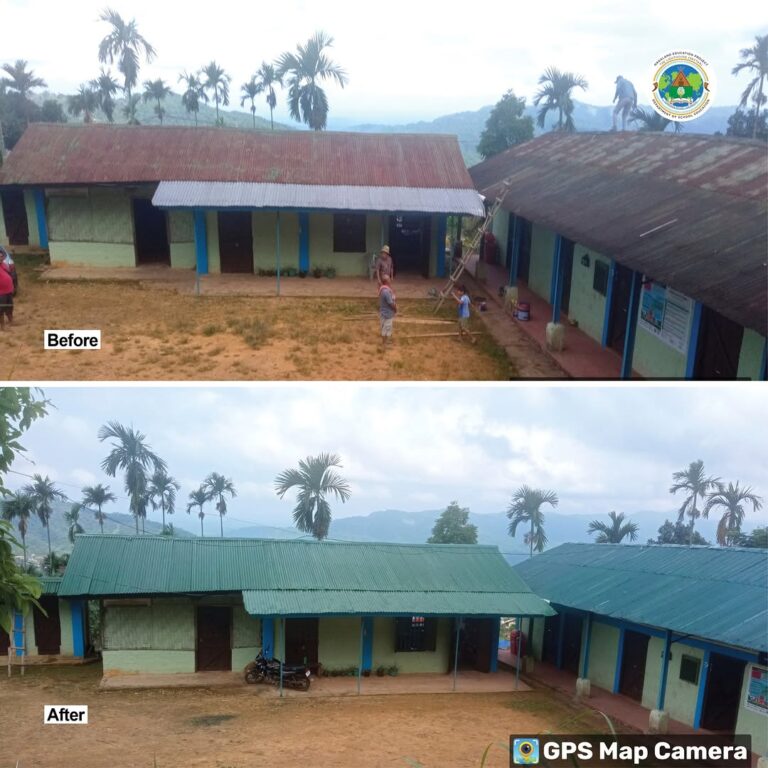
Currently, we can see some improvements in student learning outcomes, teacher attendance, efficient resource sharing through Peer Group learning, beautification of schools, and better application of Teaching and Learning Materials through the Performance Incentive Grants, among others. However, the biggest challenge that the State and the Department of School Education will have to face after the project concludes is the commitment and resources needed to sustain the reforms that have been put in place.
One thought lingering in my mind is that our social capital was harnessed at the village level in 1982 towards the development programmes of our villages, fuelling the famous Village Development Board (VDB) of the Rural Development Department. Our social capital was also harnessed in 2002 to encourage community-led development through the Nagaland Communitisation of Public Institutions and Services Act of 2002. Now, in 2026, with reforms put in place by NECTAR, it should ignite us to come up with our own State Right to Education Act for our children.
5. Given your extensive experience in government service, could you identify some areas in which the Department of School Education could improve and also suggest some ways to move forward?
A. Through NECTAR, the Department has introduced various significant interventions and it would do well to continue the following initiatives of the project:
I. Improvement in manpower management and information system including error-free and fair cadre management
II. Improvement on teacher attendance management through the SMILE App covering the entire workforce of School Education Department
III. Improvement in the teaching and learning environment with properly identified Head of Institution at the Primary and Middle levels and properly specified delegation of authority
IV. Scout for ways and means to continue the Performance Incentive Grants (PIG) system with limited and manageable resources
V. For any program to succeed and to continue its progress, those at the helm have a great responsibility, either for improvement or destruction. Therefore, timely training of manpower at all levels, as introduced under NECTAR, needs to be carried forward in a cost-effective manner.